For your Health Issues
The Durban Lesbian & Gay Community & Health Centre (a project of the KZN Coalition for Gay & Lesbian Equality) is a Drop-In Centre, safe and secure space for lesbian, transgender, gay, bisexual, and intersex communities in Durban and KwaZulu-Natal.
42 McKenzie Road, Morningside, Durban, 4001
T: 031 312 7402
F: 031 312 8838
E: admin@gaycentre.org.za
Whatsapp: 083 748 9565
Facebook: Durban Lesbian and Gay Centre // Durban Pride
http://www.gaycentre.org.za
For Gender Based Violence & Femicide Issues
The NSM is a non-profit organisation established in 2008 at a conference of shelters nationally. The Nisaa Institute for Women’s Development serves as its secretariat. Its membership currently consists of 78 shelters spread across all nine provinces of South Africa.
*120*7867# From any cellphone
support@gbvf.org.za
GBV COMMAND CENTRE: 0800 428 428
Gender Abuse Helpline: 0800 150 150
National Police Number
10111
086 10111
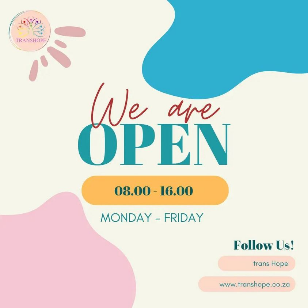
For Transgenders in KZN
Bringing hope to the trans and gender diverse community
065 826 0386
U 49 Igagasi Avenue 4066 Durban, South Africa
info@transhope.co.za
www.transhope.co.za.
Deaf Culture
What is Deaf Culture?
As a linguistic minority, deaf people share many similar life experiences, which manifests into the deaf culture. According to the World Federation of the Deaf, it includes “beliefs, attitudes, history, norms, values, literary traditions and art shared by those who are Deaf”. Also, probably the main aspect of deaf culture is the use of Sign Language as the main form of communication.
Deaf culture has many of its roots in the educational background of the community, because that is where Sign Languages usually originated and are more broadly assimilated.
On top of that, many individuals are introduced to the deaf culture when joining schools for the Deaf, since most of them are born into hearing families.
Another important aspect of deaf culture is the idea of deaf gain. It goes against the medical term ‘hearing loss’, focusing on all the positive experiences acquired with deafness instead of the sense of hearing that isn’t present.
In summary, deafness is not something that needs to be fixed, it is just a different way to experience life, rooted in a visual world.
What is unique about deaf culture?
Every culture is unique on its own and has its characteristic traits. For deaf culture it is not different.
As we have said before, Sign Language is deeply valued, alongside a reliance on eyesight, that supports a visual lifestyle. Also, people from the deaf community develop deep connections with each other, creating a very powerful nationwide network. Another important aspect is the use of technology to overcome communication barriers, which we will talk more about later on.
As any other culture, it also has strong cultural traditions in its organizations, such as deaf clubs, schools and religious institutions. It also developed its specific norms and behaviors, like a communication etiquette, which we will explore further along.
What are the five aspects of deaf culture?
There are some key aspects that represent deaf culture, let’s dive deeper into them:
Language:
the use of Sign Language, which we have said before, and will continue to say it. It is important to know that Sign Languages have their own structural and grammatical composition and rules. They are not just a signed translated version of the country’s oral language.
Values:
it is essential to preserve Sign Language literature, heritage and other forms of arts and legacies. Alongside that, clear communication is very much valued as well.
Traditions:
Stories from other deaf generations, shared experiences and participating in important events for the community.
Norms:
communication etiquette is a must. You have to know about the importance of eye contact, how to communicate and get people’s attention properly. For example, when trying to call for someone, instead of shouting their name, try tapping on their shoulder or delicately turning the lights on and off.
Identity:
accepting and recognizing one self as part of this community, participating and being proud of its culture and heritage.
What is Some Terminology to Avoid?
Some common terms that are generally viewed as offensive within the deaf community include “hearing impaired,” “deaf-mute,” and “deaf and dumb.” These terms have some intrinsic problems, such as a deficit framing that assumes that deafness is negative, but also have contextual issues, where usage of those terms indicates that the user is unfamiliar with the deaf community. While, again, the deaf community is large and diverse and there are varied preferences within that community, it is generally best to avoid these terms.
If you are deaf and queer and you are looking for help visit KZN Deaf Help Centre at
331 On West building
West Towers 4th Floor Suite 411
or
contact them on
031 301 2757 / 082 765 2027
KwaZulu Natal Deaf Association (KZNDFA)
Telephone +27 31 201 2261
Address 180 Steve Biko Road,
Durban, 4001
Location Durban, KwaZulu-Natal, South Africa